Last week we told you why Faris Capital Partners built its own property management company – the financial misalignment that drove the decision, the infrastructure we constructed, and the returns case for investors. We received a lot of positive response to that piece, and we're grateful for it.
But there is another side of this story that matters just as much, if not more – and it is told not from the investor's perspective, but from the perspective of the person whose daily life our management decisions directly affect.
Her name is Rose.
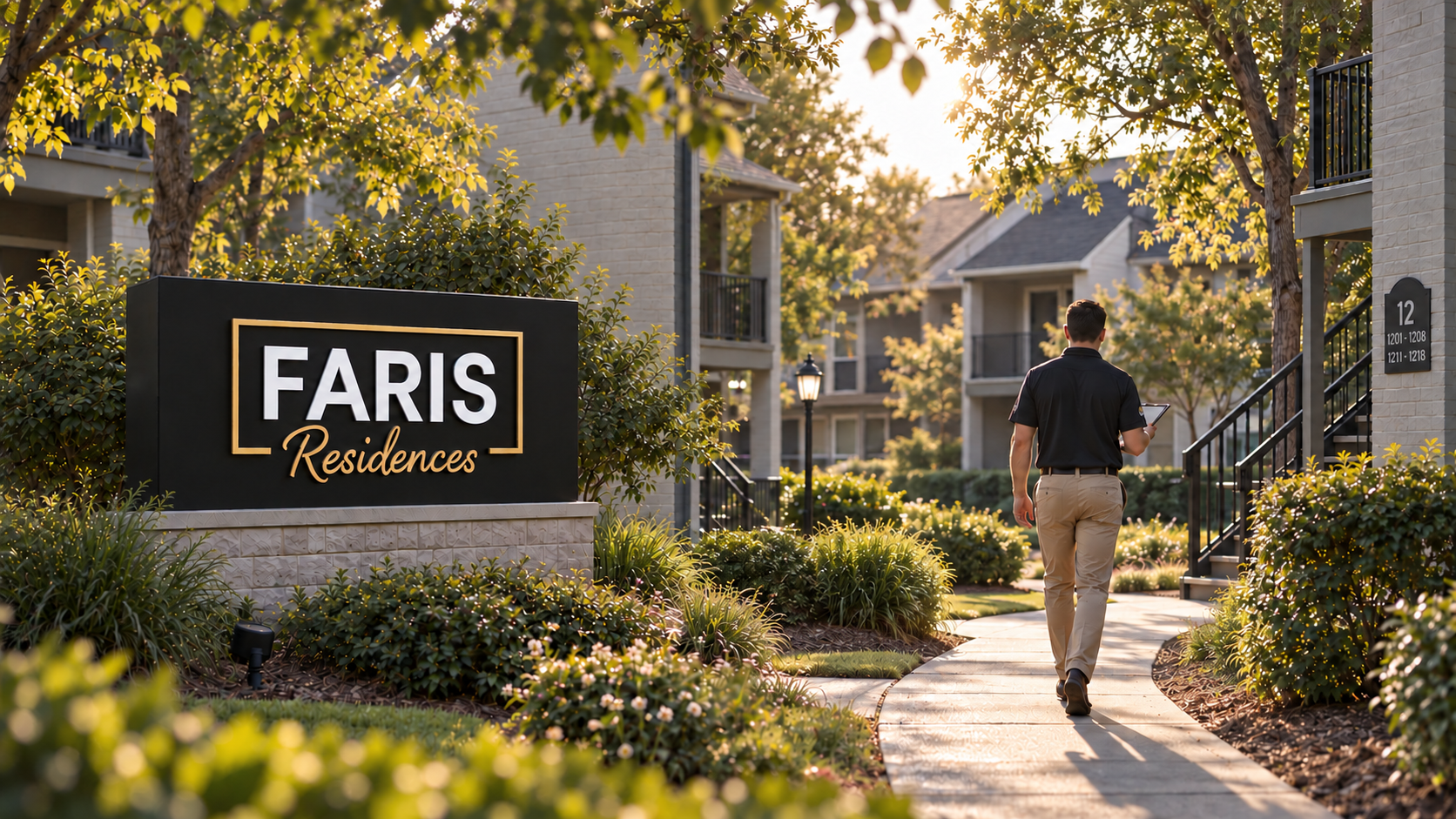
Rose is the resident persona at the center of every process we have built, every workflow we have automated, and every standard we have trained our teams to deliver. She is a workforce housing resident – an essential worker, a teacher, a healthcare professional, a first responder, someone who works hard to build a stable life and who deserves, at the end of a long day, to come home to a community that respects that work. The 'Love Lives Here' mission of Faris Residences is not a tagline for her. It is a promise.
This week's piece is about how we are keeping that promise – systematically, consistently, and at scale – across all seven Faris Residences communities, regardless of which management entity is responsible for day-to-day operations.
1) Why Consistency Is the Core Promise,and Why Systems Make It Possible
The most meaningful thing a property management company can promise a resident is not that things will never go wrong. They will. Appliances break. Maintenance requests don't always resolve on the first visit. Life happens. The meaningful promise is: when something goes wrong, you will hear from us quickly, we will take responsibility, and we will make it right.
That promise is easy to make. It is very hard to keep consistently – across multiple properties, multiple staff members, multiple time zones, and multiple management entities – without documented processes and automated systems that ensure the right action happens at the right time, every time, regardless of who is on duty.
This is the problem that our five operational manuals and 58 documented processes were designed to solve. They are not bureaucracy for its own sake. They are the engineering answer to the question: how do we make genuine care scalable? How do we ensure that a resident at Epson Oaks in Georgetown, South Carolina has the same quality of experience as a resident at Oasis at Bayside East in Largo, Florida – even though those properties are managed by the same company in very different markets?
The answer is: you document the standard, you automate the trigger, you train the team, and you measure the result. That is what we have built. And it is worth explaining in detail – because understanding the process is understanding the promise.
Investor takeaway: A consistent resident experience is not just a mission statement – it is a direct driver of renewal rates, resident satisfaction, and NOI. Communities that deliver consistent, responsive, respectful service retain residents at higher rates than communities that don't. Our operational systems are the mechanism by which the 'Love Lives Here' mission converts to financial performance.
In simple terms: Caring about residents is the intention. Having a documented system is what makes that intention show up reliably, every day, at every property – not just when the right person happens to be in the office. We built our systems because we wanted every Rose in every community to get the same excellent experience, no matter which property she lives in or which team member she's talking to.
2) The Five Manuals: What We Documented and Why
Our five operational manuals are the backbone of the Faris Residences resident experience. Each one covers a different domain of property management – and each one was built with Rose as the design filter: at every decision point, we asked what she needs, not just what the process requires.
Manual 1: Leasing and Resident Services. This manual governs everything that happens from the moment a prospective resident first contacts a Faris Residences community through the point they sign their lease and take possession of their home. It includes the standard for how inquiries are responded to (and how quickly), how tours are conducted, how lease terms are explained and documented, and how the application and approval process is managed. Every step is designed to make Rose feel welcomed, respected, and informed – not processed. A leasing experience that feels transactional is a retention risk before the lease is even signed.
Manual 2: Maintenance and Facilities. This is the manual that Rose interacts with most often during her tenancy – because maintenance is where the gap between a property that genuinely cares and one that merely collects rent becomes most visible. Our maintenance manual documents: how requests are submitted and acknowledged (within 24 hours), how priority is determined, how vendors are dispatched and coordinated, how completion is confirmed with the resident, and how follow-up is scheduled. It also governs preventive maintenance schedules – because the best maintenance conversation is the one that never has to happen because the HVAC was serviced before it failed.
Manual 3: Community Manager Operations. This manual defines the daily, weekly, and monthly rhythms of running a Faris Residences community. It includes opening and closing procedures, common area inspection standards, communication protocols between the site team and Faris Property Management leadership, incident reporting, and the operational cadence for lease expirations and renewal outreach. It is the playbook that ensures a community manager at any of our properties is operating from the same set of expectations and standards – not improvising based on their prior employer's way of doing things.
Manual 4: Legal Compliance and Fair Housing. This manual exists because Rose deserves to live in a community where her rights are protected, her treatment is fair, and the operator understands its legal obligations. Fair housing compliance is not a checkbox item – it is a foundational commitment that shapes how we market, screen, communicate, and operate. Our legal compliance manual documents the standards our teams are trained to follow, the scenarios that require escalation, and the procedures for documentation and record-keeping that protect both our residents and our organization.
Manual 5: Tenant Screening. This manual governs the process by which we qualify prospective residents – consistently, fairly, and legally. Consistent screening protects fair housing compliance. It also protects the community: a well-qualified resident who is set up for financial success in their unit is more likely to pay on time, renew their lease, and be a good neighbor to Rose and her community. Screening is not gatekeeping – it is community building.
Investor takeaway: The five manuals are the quality control layer between our values and our daily operations. Without them, the Faris Residences standard exists as an aspiration. With them, it exists as a documented, trainable, auditable set of behaviors that our team can be held accountable to.
In simple terms: We wrote down exactly how every important part of running our apartment communities should work – from the first phone call a prospect makes to the last walkthrough when a resident moves out. Writing it down matters because it means everyone on the team knows what 'good' looks like, new team members can be trained to the same standard, and we can check whether we're actually living up to it.
3) AppFolio Workflows: Where the Manual Becomes Automatic
Documentation is necessary but not sufficient. The best operations manual in the world doesn't help if it sits in a folder and isn't followed. The mechanism that converts our documented standards into consistent resident experience is AppFolio's automated workflow and checklist system – the operational technology layer that ensures the right action happens at the right time, triggered automatically, with accountability built in.
Here is how the key workflows function in practice:
The move-in experience. When a new lease is signed and a move-in date is confirmed, AppFolio automatically generates a move-in checklist assigned to the responsible community manager. That checklist includes: unit inspection and documentation, key and access credential preparation, welcome package delivery, utility setup confirmation, and a scheduled 72-hour follow-up call to make sure Rose's first days in her new home have gone smoothly. Nothing about the quality of a new resident's move-in experience depends on whether someone remembered to check a calendar. The system ensures it happens.
Maintenance request management. When Rose submits a maintenance request – through the AppFolio resident portal, by phone, or in person – the workflow begins immediately. The request is logged, categorized by priority, and assigned to the appropriate vendor or maintenance technician. If the request is not acknowledged within 24 hours, the system escalates it automatically to the community manager. If it is not resolved within the timeframe defined for its priority category, it escalates again – to Abel Leonardo, our Director of Asset and Property Management. Rose should never have to follow up twice on a maintenance issue without someone from our team proactively reaching out first.
The 90-day renewal cycle. Ninety days before a lease expiration, AppFolio triggers the renewal outreach sequence. This is not a form letter. It is a personalized conversation process that begins with a community manager reaching out to Rose specifically – to thank her for being a resident, to ask how her experience has been, to understand whether there are any unresolved concerns, and to discuss renewal options. The 90-day lead time exists because renewals that are won are won before a resident has mentally decided to leave. By the time a resident is comparing options elsewhere, the conversation is much harder. Our workflow ensures it starts early enough to make a real difference.
Move-out processing and unit turn. When a resident gives notice, AppFolio triggers the move-out checklist: notice confirmation, move-out inspection scheduling, security deposit calculation workflow, and make-ready task assignment. The workflow tracks completion of each task and flags any delays. A well-executed move-out protects the resident's deposit, protects our asset, and minimizes vacancy time – all outcomes that matter to Rose, to her community, and to our investors.
Preventive maintenance scheduling. Beyond reactive maintenance, AppFolio manages our preventive maintenance calendar – HVAC filter replacements, gutter cleaning, exterior inspections, smoke detector checks – all scheduled and assigned automatically on a recurring basis. Rose shouldn't know that her HVAC filter was replaced on schedule. She should just know that her unit is comfortable and that maintenance feels proactive, not reactive.
Collections and payment tracking. AppFolio provides real-time visibility into rent collection status by day of month across all managed properties. If a resident's payment hasn't posted by the third of the month, the system flags it and triggers a check-in workflow. In most cases, early outreach resolves a payment timing issue before it becomes a delinquency – which is better for the resident and better for our cash flow.
Investor takeaway: AppFolio's workflow system is not a convenience – it is the operational backbone that converts our documented standards into measurable, auditable resident outcomes. Real-time dashboards give our leadership team visibility into maintenance response times, renewal conversation status, collection rates, and occupancy across every property. We manage what we measure. And we measure in real time.
In simple terms: AppFolio is the software platform that runs the day-to-day operations of our apartment communities. What makes it valuable isn't just that it stores information – it's that it triggers the right actions automatically. When a resident signs a lease, a checklist pops up for the team. When someone submits a maintenance request, the clock starts ticking and the system escalates if a response is too slow. When a lease is coming up for renewal, the conversation is scheduled automatically – 90 days out – so we're not scrambling at the last minute. The system makes our intentions consistent.
4) The Fortis Partnership: Same Standard, Different Manager
Two of our seven Faris Residences communities – Faris Residences Goose Creek and Faris Residences Moncks Corner in South Carolina – are be managed by Fortis Property Management, a carefully selected third-party partner. We have been transparent about why: the limited partner structure at those two properties called for a third-party manager, and we respected that investor decision. But we want to be equally transparent about what that means for the resident experience – and what it does not mean.
It does not mean that Rose at Goose Creek or Moncks Corner gets a different experience than Rose at our self-managed properties. The standard is the same. The brand is the same. The mission is the same.
We selected Fortis because they operate at a level of professionalism and resident focus that is consistent with the Faris Residences standard. Here is how we ensure that alignment in practice:
- Fortis manages the two Charleston, SC properties within their custom property management software, Yardi. That means our leadership team has direct visibility into maintenance request volumes and response times, collection rates, lease expiration schedules, and renewal conversion at both Fortis-managed properties – in real time, without a report request. The information gap that characterizes traditional third-party management is eliminated.
- Faris Residences brand standards apply. Fortis operates under the Faris Residences brand and is expected to deliver the 'Love Lives Here' experience to every resident. The community presentation, the communication tone, the resident service standards – all reflect the Faris Residences identity, not Fortis's generic operational template. Rose at Goose Creek shouldn't feel like she's at a different company. She is in a Faris Residences community.
- Our 41-point diligence framework governed the selection. Before selecting Fortis, we evaluated them against a 41-question operational diligence framework covering seven modules: leasing and marketing, maintenance and facilities, financial reporting, resident services, compliance, staffing, and technology. We know what good property management looks like. We applied that knowledge rigorously to the Fortis selection rather than accepting the nearest available option.
- Regular performance reviews. Abel Leonardo conducts regular performance reviews with the Fortis team covering the same KPIs we track across our own managed portfolio – renewal rates, maintenance response times, collection performance, and resident satisfaction signals. Accountability is not optional at either set of properties. It is built into the oversight structure.
Investor takeaway: The Fortis partnership is not a compromise on the resident experience – it is an extension of the Faris Residences standard through a carefully vetted partner operating within our own systems and subject to our own oversight. The investor structure at those two properties required a third-party manager. The resident experience did not require a lower standard.
In simple terms: We don't directly manage two of our seven communities, but that doesn't mean those residents get a different experience. We chose Fortis Property Management specifically because they operate the way we expect a Faris Residences community to be run. They use incredible software, they operate under our brand, and our team reviews their performance on the same measures we use for our own properties. Rose at Goose Creek shouldn't have to wonder whether her community is being cared for. We made sure it is.
5) The Resident Journey: What Rose Actually Experiences
The clearest way to understand the impact of our systems and processes is to walk through the resident journey from first inquiry through renewal – and see where our documented processes and AppFolio workflows touch Rose's experience at each stage.
The inquiry. Rose finds a Faris Residences community online and submits an inquiry. Within one business hour (our documented standard), she receives a personalized response – not a form email – acknowledging her inquiry, providing information relevant to what she asked about, and inviting her to schedule a tour. The leasing process in our Leasing and Resident Services manual is built around her timeline and her questions, not around filling a funnel.
The tour. Rose tours the community with a leasing team member who has been trained to the Faris Residences standard. She is shown a clean, well-maintained unit. She is introduced to the community's amenities and the team members she will interact with if she moves in. She is given honest, accurate information about lease terms, fees, and what it is like to live there. No bait-and-switch. No hidden charges. No pressure. Our leasing culture is built around helping Rose make the right decision for her life – because a resident who chose her home with clear information is a resident who is more likely to stay.
The application and approval. Rose submits her application. Our Tenant Screening manual governs how it is processed – fairly, consistently, and within a legally compliant framework. She receives a decision within our documented timeline. If she is approved, the lease is clear and the terms are explained. If she is not approved, the decision and her options are communicated respectfully and honestly.
Move-in day. Rose's unit is ready. Not almost ready – ready. The move-in checklist that AppFolio generated when her lease was signed has been completed: the unit has been inspected and documented, the keys and access credentials work, the welcome package is waiting, and the utilities are confirmed active. Within 72 hours, she receives a follow-up call to make sure everything went smoothly and to give her a direct contact for any questions. Move-in day is the first day of a relationship, not the end of the leasing process. We treat it that way.
Daily life. Rose submits a maintenance request because her dishwasher is making a noise. Within 24 hours, she receives an acknowledgment and a scheduled appointment. The technician arrives at the time promised, resolves the issue, and confirms completion with her before leaving. If the issue requires a part that takes longer, she is proactively informed of the timeline – not left wondering. She didn't have to follow up once.
The renewal conversation. Three months before her lease expires, Rose receives a personal outreach from her community manager – not a form letter. The manager thanks her for being a resident, asks genuinely how her experience has been, inquires whether there is anything that could be improved, and discusses renewal options. If there is an unresolved concern, this is the conversation where it gets addressed – not after she's already decided to leave. The renewal is offered at a fair rate with transparent rationale. Rose knows what to expect. The goal is not to trap her – it is to make staying the obvious right choice.
If she moves on. If Rose's life takes her somewhere else, her move-out experience is as organized and respectful as her move-in. She knows exactly what to expect on the move-out inspection, her security deposit is handled within the legal timeline and with a clear accounting, and she leaves with a sense that this was a community worth living in – which means she might refer the next Rose.
Investor takeaway: The resident journey is the unit of value in property management. Every touchpoint is either building trust or eroding it. Our documented processes and AppFolio workflows are designed to systematically build trust at every touchpoint – not accidentally, but by design. That trust converts to renewals. Renewals convert to NOI. NOI converts to investor returns.
In simple terms: What does a great resident experience actually look like day to day? You get a real response within an hour when you ask a question. Your apartment is truly ready on move-in day, not almost ready. When something breaks, someone acknowledges it the same day and keeps you informed. When your lease is coming up, your community manager reaches out before you start shopping around – not after. And when you eventually leave, the process is organized and fair. That's the experience we're building. Not occasionally – every time, for every resident.
6) The Training Program: How Standards Become Culture
Systems and documentation are only as good as the people who execute them. The five operational manuals define the standard. The AppFolio workflows enforce the timing. But the team member who answers Rose's call, takes her maintenance request, or sits across from her in a renewal conversation is the one who makes the experience feel human – or doesn't.
This is why our six-session staff training program is as important as the manuals and the software. We are currently completing the program, which covers:
- Session 1: The Faris Residences Brand and Culture – who Rose is, what 'Love Lives Here' means in practice, and what the five FCP values – Love People Genuinely, Act with Wisdom, Deliver First Class Service, Do It Right the First Time, and Move with Speed – look like in daily interactions with residents.
- Session 2: Leasing and Resident Services – the inquiry-to-move-in process, AppFolio leasing workflows, tour standards, application processing, and the communication approach that makes Rose feel welcomed rather than processed.
- Session 3: Maintenance Operations – how maintenance requests are managed, vendor coordination, AppFolio work order workflows, response time standards, and how to communicate proactively with residents about repair timelines.
- Session 4: Legal Compliance and Fair Housing – the legal framework governing our operations, fair housing requirements and scenarios, documentation standards, and escalation procedures.
- Session 5: Tenant Screening – consistent, fair, and legally compliant screening procedures, AppFolio application processing, and how to communicate approval and denial decisions respectfully.
- Session 6: Emergency Response and Community Safety – emergency protocols, after-hours communication procedures, safety inspection standards, and how to support residents during a crisis in a way that reflects the Faris Residences commitment to their wellbeing.
Training is not a one-time event. As our portfolio grows and our team evolves, the training program will be the mechanism through which new team members – at Faris Property Management and at Fortis – are brought into the Faris Residences culture and standard. Culture is not inherited. It is taught, practiced, and reinforced.
Investor takeaway: The six-session training program is the human layer that activates the operational systems. Manuals define what to do. Software triggers when to do it. Training teaches why it matters and how to do it with genuine care – which is the difference between a process that is followed and a resident experience that is felt.
In simple terms: Writing a great operations manual matters. Training the people who follow it matters even more. Our six-session training program teaches our leasing agents and community managers not just the steps – but why those steps exist and what they mean to the resident on the other end of them. A team member who understands why she's calling Rose 90 days before lease expiration – and genuinely cares about the answer – is a very different person from one who's just completing a checklist. We're training for both.
7) What Investors Will See as These Systems Mature
We go live on October 1, 2026. The systems we have built will be running from day one – but compounding results take time. Here is the honest timeline for what investors should expect to see as the Faris Residences operational standard matures:
- Months 1-3: Team alignment and process consistency. The first 90 days of any operational transition are about making sure everyone knows the playbook and is running from it. Our Q4 2026 focus is clean data in AppFolio, full staff training completion, and establishing the renewal and maintenance rhythms that will drive retention through the next leasing cycle.
- Months 4-12: Renewal rate improvement and maintenance metric visibility. By mid-2027, we expect to see measurable improvement in renewal capture rates, declining maintenance response times, and strong on-time collection rates driven by our early-month payment tracking workflows. These will be the numbers we report in our quarterly investor updates.
- Year 2 and beyond: NOI improvement and resident tenure extension. As our community culture matures, residents who were uncertain at renewal will become long-term residents. The reputation of a Faris Residences community – clean, responsive, fair, warm – begins to attract the right residents organically rather than requiring heavy marketing spend. That reputation has real dollar value in reduced concessions, lower marketing costs, and stronger pricing power.
We will report these metrics in our quarterly updates: renewal rates by property, maintenance response times, collection performance, and NOI trajectory. We are not asking investors to trust the mission. We are committing to show the results.
Investor takeaway: The operational systems we have built are an investment – in infrastructure, in culture, and in the resident experience that drives long-term returns. Those investments compound. The best vintage for this operational infrastructure is now – before the compounding begins – just as the best vintage for a real estate acquisition is before the market fully prices in the recovery. We are building both simultaneously.
In simple terms: It takes time for a new operational system to fully mature. In the first few months, the focus is on getting the team trained and the processes running consistently. By next year, we expect to see it in the renewal numbers. By year two, we expect it to show up in the reputation of our communities – and in the NOI our investors receive. We'll share those numbers every quarter so you can see the progress for yourself.
Our Property Management Commitment to Rose – A Summary
- Every inquiry receives a personal response within one business hour.
- Every tour is honest, informative, and pressure-free.
- Every move-in is fully prepared – the unit is ready, the welcome is warm, and a 72-hour follow-up call is scheduled automatically.
- Every maintenance request is acknowledged within 24 hours and escalated automatically if response times are missed.
- Every renewal conversation begins 90 days before lease expiration – personally, proactively, and with Rose's concerns at the center.
- Every move-out is organized, respectful, and settled fairly.
- Every property – whether managed by Faris Property Management or Fortis – operates under the Faris Residences brand standard, measured by the same KPIs, and visible to our leadership team through AppFolio in real time.
The Bottom Line
Two weeks ago we announced the launch of Faris Property Management. Last week we explained why we built it and what it means financially for investors. This week we wanted to tell the story from the other side – from Rose's perspective. Rose is the workforce housing resident at the center of every decision we make about how our communities run. She's a nurse or a teacher or a first responder who works hard and deserves to come home to a place that actually cares about her. Our five operational manuals and 58 documented processes define exactly what that care looks like – from the first phone call she makes, through move-in, through maintenance, through renewal, all the way through move-out. Our AppFolio workflow system makes sure those processes happen on time, every time, without depending on someone remembering to check a calendar. And at our two Charleston, SC communities managed by Fortis, we've applied the same standard – industry-leading software, same brand, same performance reviews – so Rose there gets the same experience as Rose everywhere else. The goal is simple: when a resident lives in a Faris Residences community, she should feel like she matters. Not sometimes. Every day.
If you'd like to be added to our investor list to see future opportunities, please schedule a call with our team.