Sign-up for our exclusive new deal alerts and never miss out on exciting opportunities again.
Thank you! Your submission has been received!
Oops! Something went wrong while submitting the form.
Send a Referral
Do you know someone who would be a great fit to invest with Faris Capital Partners? Enter your, and the referral’s, information below and we will contact them within 1 business day.
Thank you! Your submission has been received!
Oops! Something went wrong while submitting the form.
The Data Is In: Multifamily Hedges Inflation Better Than Almost Anything
June 25, 2026
|
John Makarewicz
Share:
Every investor has felt the last few years differently. Some watched cash quietly lose purchasing power. Some watched fixed-rate bonds fail to hold ground. Some assumed their equity portfolios were keeping pace with rising prices, only to learn the relationship between stocks and inflation is far looser than it looks.
So which assets actually move with inflation rather than against it? A June 2026 research brief from Marcus & Millichap put hard numbers to that question, measuring how closely rent growth has historically tracked the Consumer Price Index across every major commercial property type. The results reinforce a thesis behind the strategy your capital is already invested in: well-positioned multifamily real estate is one of the most durable inflation hedges available to private investors.
Here is what the data shows, why it differs by property type, and why multifamily stands out.
1) What the Study Actually Measured – And What It Didn't
Marcus & Millichap measured the historical relationship between rent growth and inflation across the five major property types over a 25-year span, plus self-storage using about eight years of available data. To gauge how closely rent growth and inflation have moved together, the analysis used the Pearson Correlation Coefficient – a higher reading means the two have tracked each other more closely.
One caveat frames everything that follows: the study measures correlation, not causation. Inflation is one factor influencing rent growth, but so are new supply, local job growth, household formation, and affordability. The 25-year window also includes only one major inflation surge, though headline CPI reached the mid-4 percent range several times, giving the analysis multiple periods of elevated inflation to review.
Investor takeaway: The data is most useful as one piece of the investment picture, not a standalone thesis. It shows which property types have historically moved with inflation – not a guarantee that they always will.
In simple terms: The report doesn't say inflation automatically makes rents go up. It says that, historically, some property types have moved much more closely with inflation than others.
2) The Baseline: Stocks Offer Little Protection
Using the same methodology, the S&P 500 showed only a 16.8 percent correlation with inflation. Under alternative calculation methods, that relationship turned negative – suggesting equities tend to move independently of, or even inversely to, inflation. When prices run hot, in other words, the stock market is not a reliable place to preserve purchasing power.
That comparison matters because most major property types in the study showed a stronger link to inflation than this equity baseline. Real estate fundamentals are driven by lease structures, tenant demand, and local supply – different forces than the ones moving public equities day to day, which is one reason real estate plays a diversifying role alongside a portfolio of public investments.
Investor takeaway: Several property types have historically shown a stronger relationship with inflation than the broader stock market, which is part of why real estate earns its place in a diversified allocation.
In simple terms: Stocks and inflation haven't always moved together. Real estate rents, depending on the property type, have historically shown a much closer connection.
3) Lease Structure Is the Deciding Factor
The brief makes an intuitive point with real rigor: the more frequently a property can reset its rents, the more closely its income tracks inflation. A hotel can change its rates every night. A multifamily apartment usually resets rent once a year. An office lease may be locked in for several years. That single difference explains most of what the data shows.
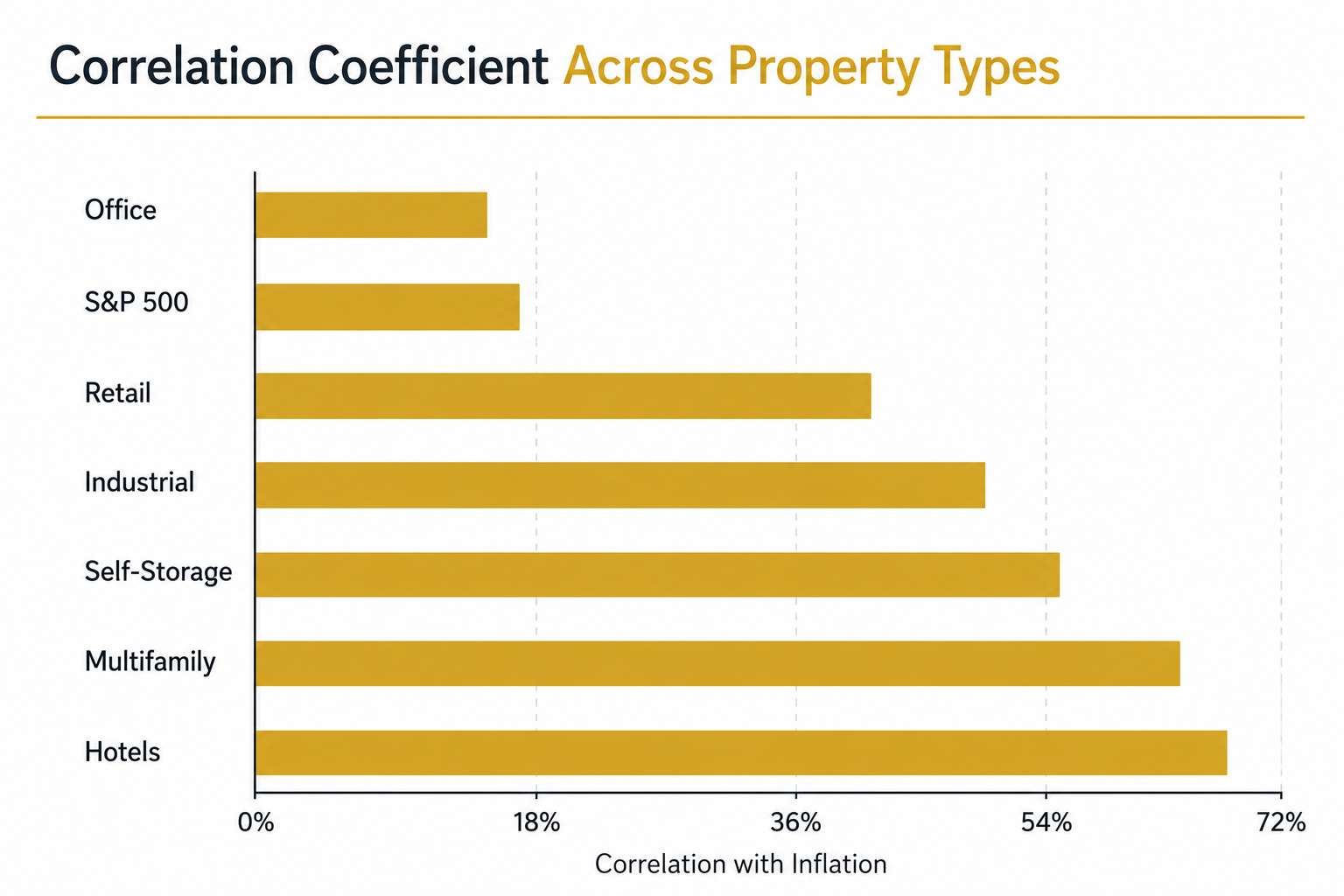
Office posted the weakest relationship of all, at 15.9 percent – even below the S&P 500 baseline – reflecting long lease terms, limited rent escalators, and the lingering drag of hybrid work. Retail improved to 39.4 percent, helped by leases more likely to carry built-in escalators. Industrial reached a moderate 49.2 percent, supported by escalators that are sometimes fixed directly to CPI; statistically, inflation explained roughly 24 percent of the variation in industrial rent growth – above the equity baseline, but below the strongest sectors.
Chart: Correlation between rent growth and inflation, by property type. Higher values indicate income that more closely tracks rising prices. Source: Marcus & Millichap Research Services.
Investor takeaway: Lease length and pricing flexibility are the mechanism. The faster a property can reset rents, the more responsive its income is to inflation.
In simple terms: A hotel can change prices every night. A multifamily apartment resets rent once a year. An office lease may be locked in for years. That's why the results come out so differently.
4) Why Multifamily Stands Near the Top
The strongest performers in the study shared one trait: short, frequently renewing leases.Self-storage registered 51.3 percent, supported by month-to-month structures – though that figure rests on the shorter eight-year dataset and was likely shaped by pandemic-era demand swings, heavy construction, and discounted street rates. Hotels topped the list at 65 percent, reflecting their ability to reprice rooms daily, with about 42 percent of their rent-growth variance statistically linked to inflation.
Multifamily was the standout among the major institutional property types, posting a 63.1 percent correlation – second only to hotels –with inflation accounting for roughly 40 percent of the movement in multifamily rent growth. The reason is lease structure: annual multifamily leases allow rents to reset far more often than office, retail, or industrial terms permit.
What sets multifamily apart is the balance. Hotels reprice daily but swing sharply with travel demand and the broader economy. Multifamily captures much of that same short-lease responsiveness while serving a fundamental housing need, so its demand base stays far steadier. Few asset classes combine the two as effectively.
Investor takeaway: Multifamily's shorter lease cycle is a core reason it has historically shown stronger inflation responsiveness than most other property types – paired with a demand base hospitality can't match.
In simple terms: Multifamily rents usually reset every year, which keeps income moving with prices. And because people always need a place to live, that demand holds steady even when the economy doesn't.
5) What This Means for Us
This research supports the way we invest at Faris Capital Partners: real estate, and multifamily most of all, may hold up against inflation far better than stocks– particularly when elevated prices persist. It's a thesis we've operated on for years, and the data gives it independent backing.
But we also recognize that a national correlation figure describes broad historical behavior; it can't replace property-level underwriting. A multifamily asset in a high-growth market with limited supply behaves very differently from a similar one facing heavy construction and softening demand. Multifamily works best as an inflation shield when paired with disciplined operations and thoughtful market selection. That's exactly why we choose our markets carefully, one at a time– favoring strong Sun Belt markets where demand stays high and rents keep growing. That discipline sits behind every investment opportunity we bring forward.
In simple terms: The data confirms multifamily can be resilient during inflation, but it still comes down to buying the right assets, in the right markets, at the right basis. That's the work we do on every acquisition.
Bottom Line
Stocks offer little protection against inflation, but real estate income tends to rise along with it – and the shorter the lease, the better it keeps up. Among the major property types, multifamily ranks near the very top, second only to hotels. Multifamily resets rents often to match rising prices, and it holds a durable demand base because people always need a place to live. Historical relationships never guarantee future results, but the data is a clear reminder of why multifamily continues to anchor a resilient, long-term strategy– and why your capital is positioned in it.
Our team specializes in identifying and renovating underperforming multifamily assets, aiming to create strong, reliable returns - even in turbulent times. We'd love to hear about your goals and discuss how value-add U.S. apartments might fit into your investment strategy.






vg.png)

d.png)

2.png)
34.png)
7.png)
ujo.png)
_cost%20of%20living.png)
cdvb.png)
fj.png)
fh.png)
bhn%2C.png)
hn.png)
rt.png)
uj.png)
vfd.png)
vfdnh.png)

bhn.png)
4e.png)
vcfcb.png)
gbtr.png)

mj.png)
nh.png)

klo.png)
_war.png)
mkj%20(2).png)


ggj.png)

p.png)

ok.png)
-n%5D.png)