For years, commercial real estate investors have treated Fed rate cuts as the signal worth waiting for, the moment when deal flow returns, cap rates compress, and asset values recover. New research from Newmark suggests that assumption may not holdup as well as the industry has assumed. The data points to a more counterintuitive story: some of the strongest periods for commercial real estate performance have come while rates were rising or holding steady, not falling.
For multifamily investors in particular, this has direct implications for how deals get underwritten, which assets deserve a premium, and how much weight the Fed's next move should really carry in an investment thesis.
1) The Data: What Newmark's 33-Year Analysis Actually Shows
Newmark analyzed commercial real estate performance from 1990 to 2023, looking specifically at how returns behaved in the three years following a change in Fed policy. The results run counter to the narrative that has dominated CRE conversations for the past two years.
In the three years following a Fed rate cut, average annual returns came in at just 3.0 percent. In the three years following a period of steady rates, average annual returns rose to 8.3 percent. Following a hiking cycle, average annual returns landed at 6.9 percent. This pattern held consistently across office, multifamily, industrial, and retail property types, not just in a single sector where a one-off explanation might apply.
Investor takeaway: The data suggests rate cuts have historically been a lagging indicator of stress rather than a leading indicator of opportunity. Periods that feel the most uncomfortable in real time, rate hikes or extended holds, have actually produced stronger CRE returns than the periods that follow once the Fed starts cutting.
In simple terms: The number everyone waits for, a Fed rate cut, has not historically been the green light investors think it is. Going back more than three decades, real estate actually performed better in the years after rates stayed flat or went up, not down.
2) Why Rate Cuts Do Not Automatically Help
Lower borrowing costs are a genuine benefit on paper. The problem is context. Rate cuts rarely happen in isolation, and they rarely happen because everything is going well.
Joe Biasi, Head of Research at Newmark, points to a familiar sequence behind most cutting cycles: slower job growth, declining investor confidence, and reduced capital flows into commercial real estate. Those forces tend to weigh on property fundamentals and transaction activity more heavily than cheaper debt helps. The Fed is usually cutting rates because the economy needs support, and that same economic softness shows up in occupancy, rent growth, and investor appetite before cheaper financing has a chance to offset it.
Investor takeaway: : A rate cutis not a standalone catalyst. It is typically a response to weakening conditions, and those conditions tend to matter more for CRE performance than the rate move itself.
In simple terms: When the Fed cuts rates, it is usually because the economy is struggling, not because everything is fine. That underlying weakness, slower hiring, cautious investors, less capital moving into deals, tends to hurt property performance more than a lower interest rate helps.
3) Inflation Is Complicating the Picture Further
Persistent inflation continues to cloud the outlook for rates in either direction. Policymakers remain split on whether to hold, cut, or raise further, and that uncertainty has kept long-term Treasury yields elevated even as short-term rate expectations shift. For investors hoping a Fed cut would translate directly into meaningful financing relief, that relief has been harder to find than the headlines suggest.
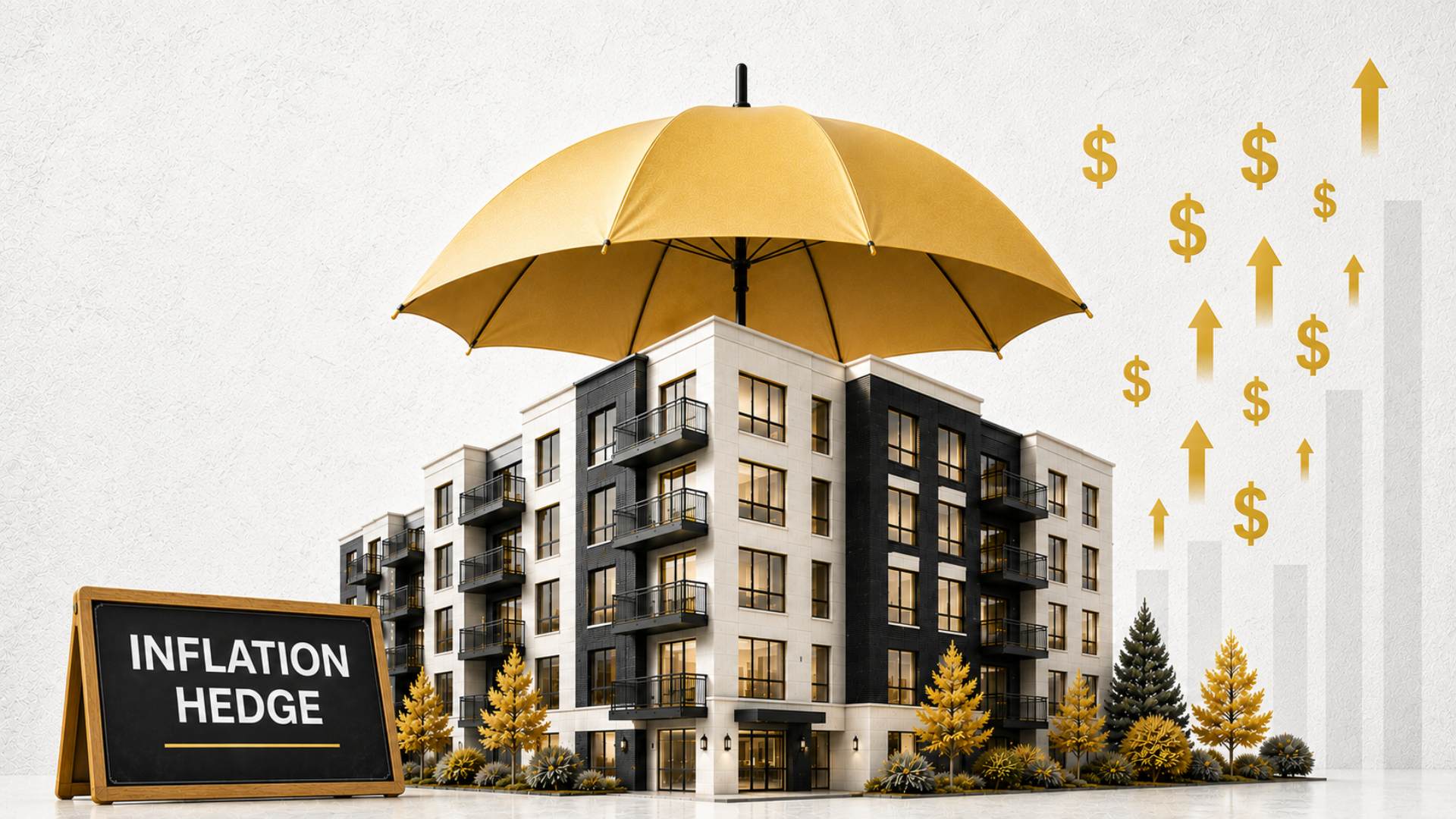
At the same time, commercial real estate's traditional reputation as an inflation hedge has weakened. Ermengarde Jabir of Moody's notes that slower rent growth, combined with rising wages, operating costs, and capital expenditures, has compressed net operating income growth across the sector. The asset class that once benefited almost automatically from inflation now requires more careful underwriting to deliver that same protection.
Investor takeaway: Inflation is working against CRE investors from two directions at once, keeping long-term financing costs elevated while also eroding the natural inflation hedge that made real estate attractive in the first place.
In simple terms: : Even if the Fed cuts short-term rates, long-term borrowing costs have stayed high because inflation will not fully cooperate. And real estate is not automatically protecting investors from inflation the way it used to, since rising costs are eating into property income growth.
4) A Different Playbook for Underwriting
Newmark's conclusion is straightforward: underwriting deals around the assumption of future rate cuts is a riskier strategy than it appears. Instead, the firm recommends prioritizing assets with strong, durable rent growth that does not depend on favorable rate conditions to perform.
This distinction matters most in multifamily and industrial, where compressed cap rates have often relied on lower interest rates to support projected returns. A deal underwritten primarily on the hope of future rate relief carries meaningfully more downside risk than a deal underwritten on fundamentals such as job growth, population growth, and genuine rental demand.
Investor takeaway: The strongest protection against rate uncertainty is not a rate forecast. It is buying assets in markets with real, durable demand drivers that produce rent growth regardless of what the Fed does next.
In simple terms: Rather than betting on when or if rates will come down, the smarter approach is to invest in properties and markets where rents are growing because people genuinely want to live there, not because financing got cheaper.
What We're Watching Next
- Fed policy signals: Continued division among policymakers on whether to hold, cut, or raise rates further, and how that division affects long-term Treasury yields.
- Inflation trajectory: Whether sticky inflation eases enough to bring meaningful movement in long-term financing costs, separate from short-term Fed decisions.
- NOI growth across the portfolio: Whether rent growth is keeping pace with rising operating costs, wages, and capital expenditures, the core test of whether the inflation hedge thesis still holds for a given asset.
- Cap rate behavior in multifamily and industrial: Whether cap rates in these sectors remain dependent on rate relief or begin to reflect underlying fundamentals more directly.
Our 2026 Playbook
- Markets: Dallas-Fort Worth, Houston, Atlanta, Tampa, Charleston, markets where employment growth, wage gains, and a shrinking construction pipeline support durable renter demand rather than requiring rate relief to work.
- Acquisition edge: Below replacement cost with day-one or near-term cash flow. A shrinking construction pipeline and easing supply pressure support the case for disciplined acquisitions now, ahead of a broader recovery.
- Value creation: Livability-first capex: kitchens, LVP flooring, lighting, bath refresh, smart access, pet amenities, package rooms, safety lighting, and landscaping. As concessions burn off and effective rents recover, communities with demonstrated rent premiums from renovations capture more of that improvement than unimproved properties.
- Operations: Renewal-centric mindset, responsive maintenance, transparent fees, and clinical pricing. In an improving market, the communities that have built resident loyalty through excellent service convert the macro improvement into actual NOI first.
- Capital structure: Conservative leverage, assumption-first where it makes sense, and multiple exit paths (hold/refi/sell) based on data – not headlines.
Bottom Line
The data says the thing everyone is waiting for, a Fed rate cut, has not historically been good news for commercial real estate. Going back more than thirty years, real estate returns were actually stronger in the years after rates held steady or went up, mostly because rate cuts tend to happen when the economy is already struggling. Inflation is making things harder too, keeping long-term borrowing costs elevated and weakening real estate's old reputation as an inflation hedge. The smartest response is not to wait for the Fed. It is to invest in markets and properties with real rent growth and strong fundamentals that holdup no matter which way rates move.
If you'd like to be added to our investor list to see future opportunities, please schedule a call with our team.



fh.png)



2.png)
34.png)
7.png)
ujo.png)
_cost%20of%20living.png)
cdvb.png)
fj.png)
bhn%2C.png)
hn.png)
rt.png)
uj.png)
vfd.png)
vfdnh.png)
bhn.png)
4e.png)
vcfcb.png)
gbtr.png)

mj.png)
nh.png)

klo.png)
_war.png)
mkj%20(2).png)


ggj.png)

p.png)

ok.png)
-n%5D.png)