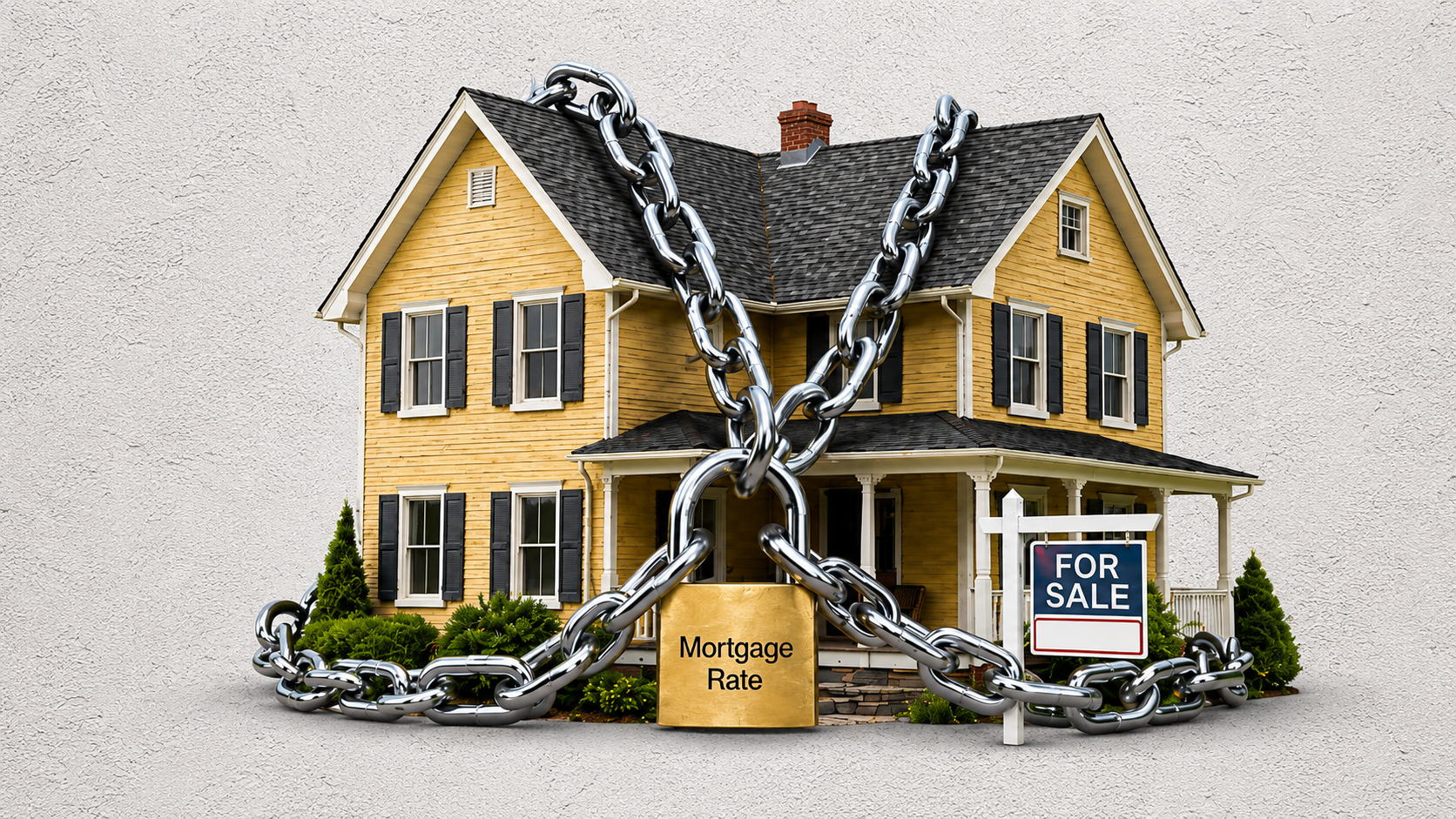
There's a phenomenon playing out across the U.S. housing market right now that rarely makes the front page, but is reshaping rental demand in ways that apartment investors need to understand clearly. It's called the mortgage rate lock-in effect, and according to the latest data, it is not fading. It is deepening.
The premise is simple. During the pandemic years of 2020 and 2021, the Federal Reserve dropped interest rates to near zero. Millions of American homeowners refinanced their mortgages, many into rates below 3%, nearly all into rates below 4%. Those monthly payments are extraordinarily low by any modern standard. When mortgage rates climbed to 7% and 8% in 2022 and 2023, and have since settled into a "higher for longer" band above 6%, those homeowners found themselves in a bind: selling means trading a 3% mortgage for a 6.5% one, often on a more expensive home. The monthly payment doesn't just go up, it more than doubles. Most households faced with that math have reached the same conclusion: stay put.
The result is a frozen for-sale housing market with historically low inventory, a persistent homeownership affordability gap, and a growing pool of households that are renting longer than any prior generation, not necessarily by choice, but because the financial math of buying simply doesn't work. For investors in multifamily real estate, particularly Class B value-add apartments serving the middle-income renter, the lock-in effect is one of the most powerful structural demand drivers in the market today. And it's one that very few mainstream real estate commentators are covering with the depth it deserves.
Here is the full picture: the data, the mechanics, the timeline, and what it means specifically for apartment investors.
1) The Scale of the Lock-In: 50+ Million Mortgages Still Below 4%
The lock-in effect's staying power comes down to one fundamental fact: the number of sub-4% mortgages is eroding extremely slowly. This isn't a problem that resolves in a year or two, it is a multi-year structural condition baked into the mortgage market.
As of Q4 2025, 50.6% of all outstanding U.S. mortgages carry rates below 4%, per FHFA data analyzed by Wolf Street (March 27, 2026). That figure represents tens of millions of households. Within that group, 19.7% of all mortgages are below 3%, down from a peak of 24.6% in Q1 2022, but declining at what Wolf Street describes as a "snail's pace". At the current rate of erosion, meaningful normalization of the mortgage rate distribution is a multi-year process, not a near-term event.
Additional context from CalcLogix and Realtor.com projections shows that roughly 81% of all outstanding U.S. mortgages carry rates below 6%,, meaning even homeowners who didn't get the ultra-low pandemic rates still face a meaningful payment increase if they sell and rebuy at today's levels. The lock-in effect is not limited to the sub-3% cohort. It affects anyone who financed a home before rates normalized above 6%, and that is the overwhelming majority of current homeowners.
The Bankrate survey data puts a human face on these numbers: 54% of U.S. homeowners said in 2025 they would not feel comfortable selling at any mortgage rate, up 12 percentage points from the prior year. The hesitation is most acute among the lowest-rate holders: 41% of homeowners paying below 3% say they wouldn't consider buying again at any rate, per Bankrate data cited by CNBC (July 2025). These are not people being irrational. They are people accurately calculating that selling and rebuying would significantly worsen their financial position, often by hundreds of dollars per month, and choosing not to do it.
Investor takeaway: The scale and persistence of the lock-in effect is larger and longer-lasting than most market commentators acknowledge. With more than half of all U.S. mortgages still below 4% as of Q4 2025 and the erosion rate slowing rather than accelerating, this is a structural condition that will continue defining the housing market, and the rental demand picture for years, not months.
In simple terms: More than half of all Americans who have a mortgage are paying less than 4% interest. If they sold their home and bought a new one today, their rate would likely be more than 6% and their monthly payment would jump dramatically. Most of them are choosing to stay put. That's a completely rational decision, but it has a major ripple effect on the whole housing market.
2) The Payment Math: Why Selling Makes No Financial Sense for Millions
To understand why the lock-in effect is so persistent, it helps to look at the specific payment math facing a typical locked-in homeowner.
Realtor.com's analysis is precise: homeowners with a mortgage rate under 4.5% face a 73.2% increase in monthly principal and interest if they sell and buy a comparable home at current rates. Concretely, that means a payment of roughly $1,300 per month in principal and interest jumping to approximately $2,236 for the same sized home in the same neighborhood. That's a $936 monthly increase, before accounting for higher home prices, property taxes, insurance, or maintenance costs.
For a household earning the median U.S. income of approximately $80,000, that additional $936 per month represents more than 14% of gross monthly income---on top of an already-elevated housing cost. The math pushes homeownership well past the traditional 30% income threshold for affordability into genuinely unworkable territory for most middle-income families.
And critically, rates are not expected to fall back to pandemic levels. Most forecasts show 30-year fixed rates stabilizing in the 6%–6.5% range through 2026 and into 2027. NAHB Chief Economist Robert Dietz stated in February 2026 that "a sustained sub-6% mortgage rate will likely wait until 2027." RSM's Chief Economist Joe Brusuelas forecasts U.S. economic growth of 2.2% in 2026 with no dramatic rate relief on the horizon. For homeowners waiting for rates to drop back to 4% before selling, a level that Kiplinger describes as a plan that "may mean waiting a very long time", the financial reality is that the lock-in is likely to remain in place for their foreseeable future.
Reid Realtors' April 2026 analysis describes the market impact with precision: in a typical year, about 5% of homeowners sell their homes because of job changes, family growth, downsizing, divorce, death. Starting in 2022, that churn dropped by roughly half. The MBA's estimate of 1.3 to 1.5 million homes kept off the market annually as a direct result of the lock-in effect represents a staggering volume of suppressed supply, equivalent to nearly an entire year of new home construction simply disappearing from available inventory.
Investor takeaway: The payment math of the lock-in effect is not a psychological phenomenon, it is a precise financial calculation that millions of homeowners are making correctly. Until rates normalize significantly and current forecasts suggest that is years away, the incentive to stay put will remain overwhelming for the majority of locked-in homeowners. That sustained supply suppression is the direct mechanism through which the lock-in effect benefits apartment investors.
In simple terms: The math is simple but powerful. If you're paying $1,300 a month on your current mortgage and selling and buying again would cost you $2,236 a month, for the same house, you're not selling unless you absolutely have to. And most people don't absolutely have to. So they stay. And that means fewer homes for sale, higher home prices, and more people renting instead of buying.
3) The Inventory Consequence: A For-Sale Market Frozen in Time
The lock-in effect's most immediate consequence is historically low existing home inventory, and it is one of the most unusual conditions in the modern housing market.
The National Association of Realtors tracks existing home sales, and the data is stark. Spring 2025 volume tracked at levels last seen during the 2009 housing crash, not because homes are underwater or the economy is in freefall, but because homeowners simply won't list (Bankrate/CNBC, July 2025). The MBA's analysis of the lock-in effect confirms that the 1.3 to 1.5 million suppressed listings per year represent a structural reduction in inventory that has persisted for three straight years and shows no signs of rapid normalization.
Some modest improvement is visible: Realtor.com reported 1.1 million active listings nationally in late 2025, the highest level since 2019, and inventory is described as now within 9% of pre-pandemic norms on a national basis (Reventure, December 2025). But there is an important caveat: 2019 was already an undersupplied market. Returning to 2019 inventory levels doesn't solve the underlying shortage, it returns the market to conditions that were already inadequate to meet demand. Closing the structural 4.7 million home deficit that Zillow and NAR have documented would require sustained above-normal construction for a decade, which the tariff environment and tight financing conditions are making even less likely.
Fannie Mae's research adds an important nuance: the lock-in effect is not the only force suppressing inventory. The long-run decline in consumer mobility, from 16.8% of households moving annually in 2006 to just 12.6% in 2022, predates the pandemic and reflects deeper structural shifts in American housing behavior. The Fannie Mae analysis concludes that even if mortgage rates dropped meaningfully, it would "not expect to see a surge in home listings" because the lock-in is reinforced by multiple other factors including aging demographics, accumulated equity, and the general friction of moving. The frozen market, in other words, has deeper roots than rates alone.
Investor takeaway: The inventory crisis in the for-sale market is not resolving quickly and the forces sustaining it extend well beyond the interest rate differential. Even a meaningful drop in mortgage rates would not produce a sudden flood of listings, because the lock-in effect is reinforced by equity accumulation, demographics, and structural mobility decline. For apartment investors, that means the for-sale market constraint that keeps would-be buyers renting is a multi-year condition, not a temporary dislocation.
In simple terms: There are so few homes for sale right now that spring 2025 sales volumes looked like the 2009 financial crisis, not because the economy is crashing, but because homeowners simply won't list. Even as inventory ticks up slightly, we're only returning to 2019 levels and 2019 was already short of homes. The for-sale market is frozen, and it won't thaw quickly. That keeps more people renting, often in the same quality communities they might have otherwise left to buy a home.
4) The Apartment Demand Consequence: A Renter Pool That Won't Stop Growing
The direct consequence of the lock-in effect for apartment investors is a renter pool that is larger, more stable, and more financially capable than at any prior point in modern history. The data confirms this from multiple angles:
- Record renter household formation. Harvard JCHS reports a record-high 784,000 new apartment households formed in Q2 2025 alone, driven directly by the high cost of homeownership keeping would-be buyers in the rental market. Even as some of that pace moderated later in the year, the structural demand floor remained intact.
- Higher-income households staying in the rental market. The number of renter households earning $75,000 or more in inflation-adjusted terms rose by 1.7 million from 2021 to 2024 (Harvard JCHS). These are households that in prior generations would have transitioned to homeownership by this life stage, but the locked for-sale market and unaffordable purchase prices have kept them renting. Higher-income renters are the most desirable resident profile for Class B communities: stable income, quality-conscious, and less likely to leave for a cheaper option.
- Renewal rates at historic highs. CBRE's 2026 Multifamily Outlook reports that 57% of all leasing activity in 2026 is renewals, up from 51% in 2015 and 48% in 2005. Equity Residential reported just 7.2% of residents moved out to buy homes in Q2 2025, a record low. The lock-in effect is not just keeping new renters from leaving for homeownership, it is keeping current apartment residents in place longer, strengthening renewal economics across the board.
- The cost gap is at historic extremes. Viking Capital's 2026 Market Report shows the cost of homeownership is nearly three times higher than average apartment rent. CBRE data shows the average monthly mortgage payment ($2,339) is nearly 35% higher than the average multifamily rent ($1,737). The National Apartment Association confirms: "high mortgage costs continue to push would-be buyers into rentals" and rental demand is expected to outpace new deliveries throughout 2026.
- Multifamily absorption remains resilient. Despite the headline softening in asking rents driven by the Class A new supply wave of 2022–2025, net absorption of apartments remained strong at 463,000 units in the 12 months ending September 2025 (CoStar, cited by NAA). The renter pool isn't shrinking. It is absorbing new supply and holding firm.
Investor takeaway: The lock-in effect has fundamentally altered the composition of the renter pool by making it larger, older, better-compensated, and more likely to renew than at any prior point in the modern apartment era. These are not distressed renters who can't afford anything better. These are households making a rational financial choice to rent quality apartments rather than overpay for homeownership in a locked market. That choice benefits well-operated Class B multifamily communities directly.
In simple terms: Because buying a home is so expensive right now, more people are staying renters longer and many of them earn good incomes. They're not renting because they can't do better; they're renting because it's the smart financial move when homeownership costs nearly three times as much. These are exactly the kinds of residents that make apartments profitable to own: they pay their rent, they renew their leases, and they stay for years at a time.
5) The Lock-In Effect Is Slowly Easing, But "Slowly" Is the Key Word
A fair analysis of the lock-in effect requires honesty about one thing: it is not permanent. Life does not wait for mortgage rates. Divorces happen. Job relocations happen. Families outgrow starter homes. Retirees downsize. These "trigger events," as the National Association of Realtors calls them, continue to force some homeowners into the market regardless of the rate differential. And over time, as more homeowners originate mortgages at today's rates, either through recent purchases or eventual forced sales, the share of sub-4% loans will gradually shrink.
The early signs of this easing are visible. Inventory has risen from its 2023–2024 lows toward 2019 levels. Some markets, particularly in the South where new construction added supply, have already seen conditions normalize somewhat. Kiplinger reported in January 2026 that "new data and early 2026 market signals suggest that the grip of that effect may be starting to loosen" as more homeowners carry mortgages closer to today's rates.
But "starting to loosen" is very different from "resolving". Wolf Street's March 2026 analysis of FHFA data shows the share of below-3% mortgages declining from 24.6% at peak to 19.7% in Q4 2025, a drop of just 4.9 percentage points over three and a half years. At that pace, the below-3% cohort alone, not counting the larger below-4% group, will persist well into this decade. The MBA's Fannie Mae cited research specifically warns against expecting a surge in listings even if rates decline, because the lock-in effect is reinforced by factors that won't change with rates.
The Fortune analysis from April 2026 frames the trajectory accurately: "For three years, the U.S. housing market hasn't been in decline, it's been at a standstill." The gradual normalization of the lock-in effect means more inventory trickling into the market over time, but not a flood. And a trickle of new listings does not rapidly improve affordability in a market that needs millions of additional units to close the structural shortage.
Investor takeaway: The easing of the lock-in effect is a long-duration story measured in years, not quarters. Even as the effect gradually weakens, the sub-4% mortgage cohort will remain a meaningful share of all outstanding loans through the end of the decade. For investors in apartment communities with 3–5 year hold periods, the lock-in effect will be a structural tailwind throughout the entire investment lifecycle of deals being underwritten right now.
In simple terms: Yes, the lock-in effect is slowly fading. Some homeowners are finally selling because life events force them to. But 50% of all mortgages are still below 4%, and that share is shrinking at a snail's pace. For apartment investors with a 3 to 5 year timeline, this demand driver isn't going anywhere. It will be working in our favor for the entire life of deals we're making today.
6) What the Lock-In Effect Means Specifically for Class B Value-Add Apartments
Not all apartment types benefit equally from the lock-in effect. The demand it generates is concentrated in a specific profile: middle-income renters who want quality but can't justify the cost of ownership. That is the exact renter profile that Class B value-add communities serve.
Consider who the lock-in effect is keeping in the rental market. It is not the renter earning $30,000 who was never going to buy a home regardless. It is the household earning $65,000–$100,000 who could potentially qualify for a mortgage, but looks at the math and concludes that renting a well-maintained apartment at $1,400–1,800 per month is far more financially sensible than committing to a $2,300–2,500 monthly mortgage payment on an overpriced home. That resident is exactly the person who chooses a renovated Class B apartment with updated kitchens, durable flooring, good lighting, pet amenities, and responsive maintenance.
REEP Equity's analysis confirms this directly: "A growing segment of former homeowners, priced out of homeownership by rising mortgage rates and property values, now represents a stable tenant base for quality Class B properties. These renters often stay longer, maintain properties better, and provide more predictable income streams for investors." This is not a theoretical benefit. It shows up in the renewal rates, occupancy metrics, and NOI data of well-operated Class B communities every month.
The lock-in effect also interacts powerfully with our operational philosophy. Because locked-in renters are staying in apartments by rational financial choice rather than desperation, they have options, including eventually buying when rates normalize. That means they respond to quality and service. Communities that deliver clean, well-lit environments, responsive maintenance, transparent fees, and thoughtful amenities capture and retain these residents at higher rates than communities that don't. The lock-in effect puts quality-conscious residents in the market. Excellent operations are what keeps them.
Investor takeaway: The lock-in effect is not just filling apartments, it is filling them with a higher-quality, more financially stable, more renewal-prone resident cohort than the pre-2022 apartment market produced. For Class B value-add operators focused on renewals and livability, this is a compounding advantage, the right residents, choosing the right product, in a market where buying them a home as an alternative keeps getting more expensive.
In simple terms: The people being kept in the rental market by the lock-in effect are exactly the people our apartments are designed for. They earn decent incomes, they value quality, and they're renewing their leases instead of buying homes. They're not distressed renters, they're pragmatic ones. And pragmatic, financially stable renters who choose to stay are the best residents an apartment community can have.
7) How This Plays Out in Our Target Markets
The lock-in effect doesn't distribute evenly, and our five target markets are each positioned to benefit from its demand dynamics in specific ways:
- Dallas–Fort Worth: DFW's rapid corporate relocation activity and high wage growth have created a large cohort of professional renters who arrived in the metro after 2022 and are building equity through careers rather than real estate. With the Texas Stock Exchange opening, Goldman Sachs expanding, and wages growing at 6% annually, the DFW workforce renter pool is deep, income-growing, and increasingly locked out of for-sale homeownership by prices that have risen sharply with the population boom.
- Houston: Houston's energy, healthcare, and professional services workforce represents a classic lock-in demographic: stable employment, middle incomes, and homeownership aspirations that the current rate environment is deferring. Healthcare and social assistance alone are adding 14,000 jobs in 2026, workers who will need quality rental housing in a market where the for-sale entry-level segment is constrained.
- Atlanta: Atlanta's combination of fourth-highest national job growth and a supply pipeline that is shrinking sharply creates exactly the conditions where the lock-in effect concentrates demand into the existing rental stock. With multifamily deliveries dropping to the slowest pace in a decade and 19,000 new jobs arriving in 2026, the apartment absorption math strongly favors stabilized Class B communities.
- Tampa: Tampa's domestic in-migration, driven by Northeast and Midwest households seeking affordability, means many new arrivals are arriving as renters by circumstance: they sold a home in a more expensive market but can't afford to buy in Tampa's appreciating market immediately. These are high-quality, financially stable renters with homeownership intent but rental-market behavior, exactly the lock-in profile.
- Charleston: Charleston's corporate relocation activity tied to Google, Boeing, Eaton, defense manufacturers, is bringing high-earning professionals who are new to the metro, unfamiliar with local neighborhoods, and rationally choosing to rent before committing to a purchase. In a market where the for-sale inventory is tight and prices have appreciated sharply, renting a quality Class B apartment is the logical first step for many new arrivals.
Investor takeaway: In each of our five markets, the lock-in effect is amplified by local employment growth, population inflows, and for-sale price appreciation that makes the rent-vs-buy gap particularly wide. We are not just benefiting from the national lock-in story, we are operating in the specific metros where its demand effects are most concentrated.
In simple terms: In every city where we invest, there's a specific version of the same story: good jobs are bringing in new residents, home prices have gone up, and the math of buying a home doesn't work for a lot of households right now. That keeps our renter pool full of exactly the kind of people who keep apartments occupied and profitable.
8) What We're Watching Next
- Mortgage rate trajectory: Any sustained move below 6% on 30-year fixed rates would gradually reduce the payment gap for locked-in homeowners. Watch Freddie Mac's weekly rate survey and NAHB's commentary for signals. Current forecasts put a sub-6% rate no earlier than 2027.
- Sub-4% mortgage share: FHFA releases quarterly mortgage data. We track the decline rate of the sub-4% cohort as a leading indicator of how quickly the lock-in effect is easing. At the current pace of 1.2–1.5 percentage points per quarter, we are years from normalization.
- Renewal rate data from major REITs: Camden, Equity Residential, and AvalonBay report renewal data quarterly. If Equity Residential's 7.2% move-out-to-buy rate rises meaningfully, it would signal that the lock-in is beginning to loosen in earnest. We are not seeing that yet.
- For-sale inventory trends: Realtor.com's weekly active listing data is the most current read on whether the inventory freeze is thawing. A return to 2019 levels, already underway in some markets, is not the same as a housing market in balance, given the structural shortage that predates the pandemic.
- Wage growth vs. home price appreciation: The monthly payment gap between renting and buying narrows when wages grow faster than home prices. In our target markets, wage growth is strong, but home price appreciation has kept pace. Any sustained divergence would begin to reduce the lock-in effect's bite.
Our 2026 Playbook
- Markets: Dallas–Fort Worth, Houston, Atlanta, Tampa, Charleston— each a domestic in-migration market with strong employment, appreciating home values, and a lock-in effect that concentrates quality renter demand in the apartment sector.
- Acquisition edge: Below replacement cost with day-one or near-term cash flow. In a market where the for-sale alternative keeps getting more expensive, the attainable-quality apartment we acquire and renovate becomes more valuable relative to homeownership with every passing quarter.
- Value creation: Livability-first capex: kitchens, LVP flooring, lighting, bath refresh, smart access, pet amenities, package rooms, safety lighting, and landscaping. The locked-in renter choosing our community over buying a home responds to quality and livability, not just price.
- Operations: Renewal-centric mindset, responsive maintenance, transparent fees, and clinical pricing. The locked-in renter who is staying by rational financial choice will keep renewing as long as the community earns it. Our operations are designed to earn it, every year.
- Capital structure: Conservative leverage, assumption-first where it makes sense, and multiple exit paths (hold/refi/sell) based on data, not headlines.
Bottom Line
More than half of all American homeowners are locked into mortgage rates below 4%. With current rates above 6%, selling and buying a comparable home would more than double most of their monthly payments. So they're not selling and the for-sale housing market has been essentially frozen for three years as a result. The Mortgage Bankers Association estimates this is keeping 1.3 to 1.5 million homes off the market every year. With fewer homes to buy, more people are renting longer, including middle-income earners who are quality-conscious, financially stable, and likely to stay for years. That's a direct and durable demand driver for well-run apartment communities serving the workforce renter. The lock-in effect isn't fading quickly. At the current rate of erosion, more than 50% of mortgages will still be below 4% for years to come. For investors in value-add multifamily, that means the renter pool is deeper, more stable, and more financially capable than at almost any point in modern history and it's going to stay that way throughout the life of deals being underwritten right now.
👉 We have an active investment opportunity available now in one of these markets. Investors on our list get first access to the details.
If you'd like to be added to our investor list to learn more, please schedule a call with our team.






vg.png)

d.png)

2.png)
34.png)
7.png)
ujo.png)
_cost%20of%20living.png)
cdvb.png)
fj.png)
fh.png)
bhn%2C.png)
hn.png)
rt.png)

uj.png)
vfd.png)
vfdnh.png)

bhn.png)
4e.png)
vcfcb.png)
gbtr.png)

mj.png)
nh.png)

klo.png)
_war.png)
mkj%20(2).png)


ggj.png)

p.png)

ok.png)
-n%5D.png)