Sign-up for our exclusive new deal alerts and never miss out on exciting opportunities again.
Thank you! Your submission has been received!
Oops! Something went wrong while submitting the form.
Send a Referral
Do you know someone who would be a great fit to invest with Faris Capital Partners? Enter your, and the referral’s, information below and we will contact them within 1 business day.
Thank you! Your submission has been received!
Oops! Something went wrong while submitting the form.
Why We Built Our Own Property Management Company – and What It Means for Our Investors
September 17, 2026
|
John Makarewicz
Share:
There is a moment in the life of most growing apartment investment firms when the question stops being "how do we acquire the right assets?" and starts being "how do we make sure those assets perform the way we underwrite them?" For Faris Capital Partners, that moment arrived over the course of the past year – as our portfolio grew, as our brand sharpened, and as we became increasingly honest with ourselves about where the gap between our investment thesis and our residents' daily experience was widest.
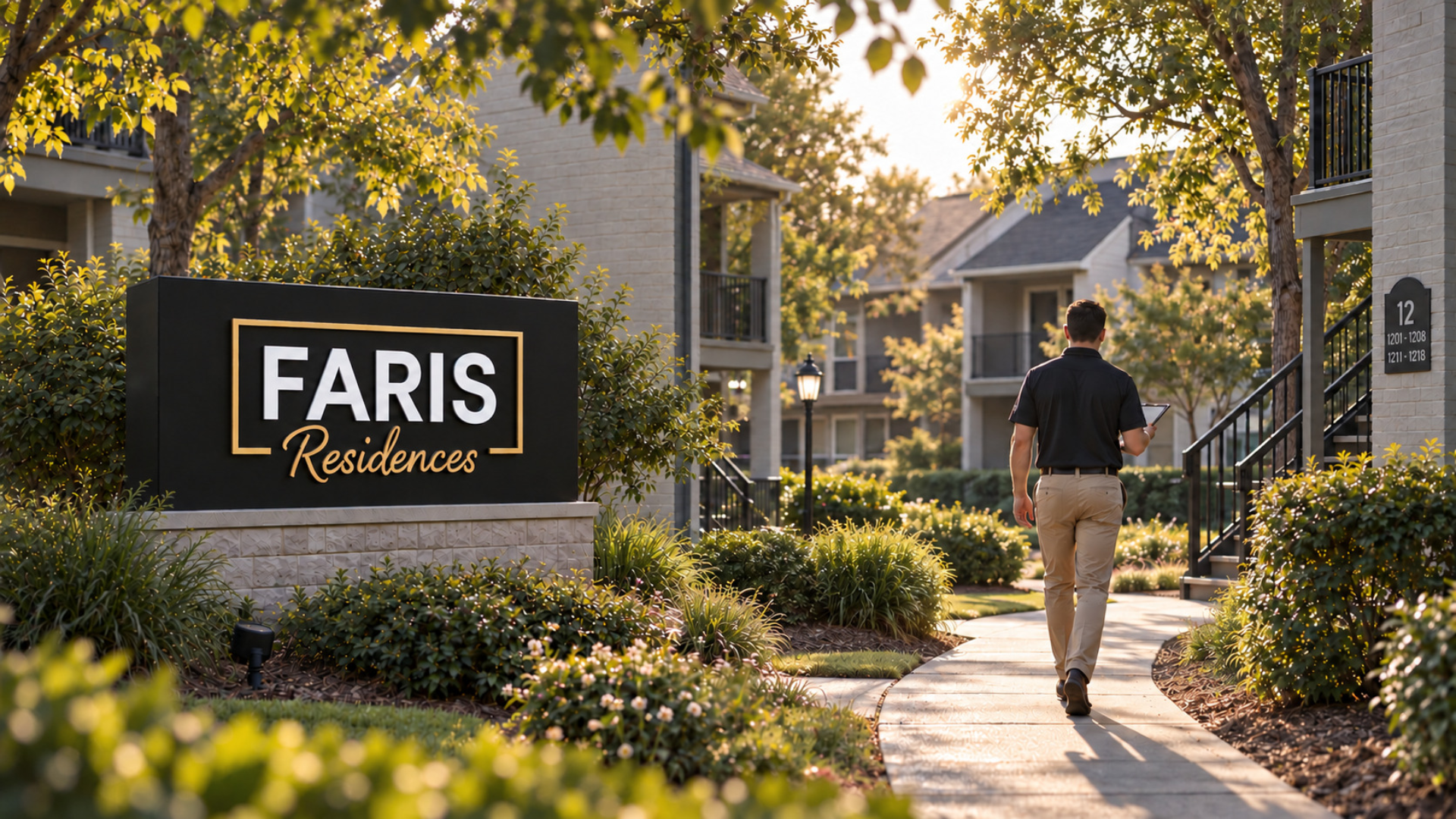
On October 1st, 2026, we will close that gap with a decision we have been working toward for months: we will launch Faris Property Management, LLC– our own in-house property management company – and take direct control of five of our seven properties across Georgia, South Carolina, and Florida.
This is the most consequential operational decision we have made since founding this firm. We want to explain it fully – why we made it, what it required, what it means for the residents in our communities, and why we believe it is one of the most important things we can do for our investors.
1) Why We Started with Third-Party Management – and Why It Made Sense
We want to be honest about this from the start: third-party property management is not inherently bad. When we acquired our first properties, it was the right choice. We didn't have the infrastructure to hire, train, and manage a property team. We didn't have the operational systems. We didn't have the volume to justify the overhead.
Third-party managers offer real value for an emerging operator: trained staff, established processes, existing vendor networks, and property management software that is already built and running. For an operator focused on acquisitions and capital formation, that is genuinely useful – it lets you move fast and learn the business while someone else handles day-to-day operations.
We were in that camp when we started. And for a certain stage of our growth, it served us. But models that serve you at one stage of growth can become constraints at the next stage. That is what happened.
Investor takeaway: The decision to use third-party management early was right. The decision to move in-house now is also right – but for reasons that are specific to where we are in our growth. Understanding that both decisions can be correct at different times is the starting point for evaluating this choice honestly.
In simple terms: When you're a small company just starting out, hiring outside help to manage your apartments makes sense. You don't have the team or the systems yet. But as you grow, the tradeoffs of giving someone else control over your residents' experience start to outweigh the convenience. That's the stage we reached.
2) What We Learned the Hard Way: The Three Gaps That Cost Us
The problems with third-party management were not dramatic. They were structural – the kind of problems that accumulate slowly and show up in the numbers before they show up in any single incident. We identified three specific gaps that ultimately drove the in-house decision.
The information gap. With third-party management, you receive the data your manager chooses to surface, in the format they format it, on the schedule they operate on. When a property's on-time collection rate is softening, you want to know that week – not when the monthly report lands. When a maintenance category is generating repeated complaints, you want to see it in real time. Data latency is a management risk, and it is a structural feature of third-party management that cannot be fully overcome by adding more reporting requests.
The accountability gap. When a resident has a maintenance issue that doesn't get resolved, who is accountable? With a third-party manager, the answer is murky. The property manager points to the vendor. The vendor points to the work order system. The owner asks the manager, who escalates. By the time the issue surfaces clearly, the resident has already formed an impression of the community – and it isn't good. This accountability gap is not a personal failure of any individual. It is structural. It is what happens when the person responsible for your resident's experience is employed by and ultimately loyal to a different company than yours.
The culture and renewal gap. We have a specific vision for what it means to live in a Faris Residences community. We have built our service model around a resident we call Rose – a workforce housing resident, an essential worker, someone who works hard to build a stable life and deserves to come home to a community that respects that. When your property is managed by a third party, your brand is an add-on. The staff are trained in that company's systems and culture. Culture is set by the people who show up every day, not by a logo on a sign.
The renewal consequence was the most financially measurable. We have talked extensively on this newsletter about why renewals are the most important operational lever in a muted rent growth environment: no concession cost, no vacancy, no turn expense, no marketing spend. A renewed resident is margin-accretive in ways a replacement resident simply is not. But renewal focus requires intentionality – reaching out 90 days before lease expiration, having real conversations about what would make the resident want to stay, addressing concerns before they become reasons to leave. That intentionality is hard to sustain consistently in a third-party structure where staff are split across many properties and may be incentivized to fill vacancies rather than prevent them. We saw the gap in our renewal numbers. We knew where it was coming from.
"Property management is where strategy meets the resident. You can buy right and underwrite well, but if the property isn't managed with intention, you leave returns on the table."– John Makarewicz, Faris Capital Partners
Investor takeaway: The three gaps – information, accountability, and culture – are not unique to any specific third-party manager. They are structural features of the model itself that emerge at a certain scale. When you are paying for and depending on a management layer between you and your residents, those gaps will exist. The question is whether they are large enough to matter – and at our scale, they were.
In simple terms: Three things bothered us about having someone else manage our apartments. We couldn't get data quickly enough to act on problems early. When something went wrong for a resident, it wasn't always clear who was responsible for fixing it. And the culture we wanted to create – one where residents feel genuinely cared for – was hard to build when the people running our communities worked for a different company. All three of those problems show up eventually in how long residents stay and how much our properties earn.
3) The Decision to Build In-House – What It Took
The decision to build in-house was not made in a single meeting. It built over time as the gap between what we needed from property management and what we were getting became too wide to close by working around it. The core realization was simple but consequential: we did not fully control the experience our residents had every day. That misalignment was a ceiling on what the portfolio could deliver – operationally and financially.
We also recognized that the portfolio had reached a scale where in-house management is justified. At 563 units across seven properties in three states, we can support a dedicated operations team, purpose-built systems, and management infrastructure that serves our portfolio specifically. The overhead that didn't make sense at two properties makes sense at seven.
We want to be transparent about the scope of what we built, because investors deserve to understand that this was not a casual decision. Here is what we actually constructed over the months leading to our August 11 go-live:
Five operational manuals covering 58 documented processes: Leasing and Resident Services, Maintenance and Facilities, Community Manager Operations, Legal Compliance and Fair Housing, and Tenant Screening. These are the operational backbone of Faris Property Management – defining how we do things, why we do them that way, and what the standard is at every Faris Residences community.
A six-session staff training program for our leasing staff and community managers, covering the systems, standards, and resident service philosophy that define the Faris Residences experience.
A complete AppFolio software migration, replacing the prior property management system and giving us direct, real-time visibility into collections, occupancy, maintenance, and lease expiration across every managed property.
Executed property management agreements across all seven properties in our portfolio – the legal infrastructure that formalizes FCP's direct management role.
Submitted lender business plans to each lender explaining the transition, our qualifications, and our operational approach. All lenders approved the change of management.
Dedicated leadership hired and placed: Abel Leonardo as Director of Asset and Property Management, and Madison McCarty as Director of Finance. These are not shared resources across a large company's portfolio – they work for Faris, and their entire focus is our portfolio.
Investor takeaway: Building an in-house property management company is not a pivot or a rebrand. It is an operational infrastructure investment that requires real capital, real time, and real organizational commitment. We made that investment because we believe the returns – financial and operational – justify it. The infrastructure we built is the foundation that makes those returns possible.
In simple terms: Building our own property management company was a serious undertaking. We wrote 58 different documented procedures. We built a training program. We changed our software systems. We got approval from every lender in our portfolio. We hired two dedicated leaders. This wasn't something we did quickly or lightly – it was the result of months of careful construction, because we wanted to do it right.
4) What Faris Property Management Actually Is
Faris Property Management, LLC is a wholly owned affiliate management company of Faris Capital Partners. It manages our portfolio directly – not as a third party, but as an integrated part of the FCP organization. Mark Faris is Manager. The company is registered in Florida, where we have our largest single asset.
This is an important distinction for investors: Faris Property Management is not an independent third party we are hiring. It is us. The management fee stays inside the FCP structure. The decisions are made by the same team making the investment decisions. The accountability is direct.
The portfolio Faris Property Management manages directly: Five of our seven properties – Epson Oaks in Georgetown, SC; Churchill Apartments and Strawberry Station in Moncks Corner, SC; Oasis at Bayside East in Largo, FL (our Tampa area asset); and Brighton Way in Smyrna, GA.
The two properties retained with a third-party manager– Goose Creek and our Moncks Corner asset – reflect the specific investor structure at those properties, where limited partners elected to retain a third-party manager. We respect that decision. We have conducted significant diligence on the manager selection and will continue to oversee performance closely. So to be precise: we have not eliminated third-party management entirely. We have taken direct control of the majority of our portfolio and are being thoughtful about vendor selection for the remainder.
Every Faris Property Management community operates under the Faris Residences brand and our 'Love Lives Here' mission. The resident persona we have built our service model around is Rose: a workforce housing resident, an essential worker, someone who deserves a home she can be proud of and a team that treats her with respect. That mission is not a tagline. It is the standard against which we train our staff, design our processes, and measure our performance.
Investor takeaway: The structure of Faris Property Management eliminates the misalignment inherent in third-party management. When the management company is us, the interests of the management company and the interests of investors are the same. There is no separate entity optimizing for its own fee structure, its own staffing model, or its own brand priorities. There is one team, one mission, one set of incentives.
In simple terms: Faris Property Management is us – it's part of our company, not an outside vendor we're paying. That means the fee for managing our apartments stays inside our organization rather than going to a third party. And it means the people making decisions about how our properties are run are the same people who are responsible to our investors for how those properties perform.
5) The Returns Case for In-House Management
The decision to build in-house management is not just operational – it is financial. Here is the direct investor case, with specific numbers.
The management fee economics. Typical third-party management fees run 6-10% of collected rents. On our 563-unit portfolio at average rents in our target range, that equated to roughly $600,000 to $700,000 per year leaving the portfolio annually to pay a third party. With in-house management, that cost is replaced by the actual cost of running our own team – salaries, benefits, software, compliance, and training. We are not claiming in-house management is free. But the economics shift from paying a percentage of revenue regardless of performance to paying for actual resources at actual cost. That is a fundamentally better structure for owners who are serious about NOI.
The renewal and retention multiplier. This is where the financial case becomes most compelling – and most specific.
A unit that turns costs us vacancy (typically 2-4 weeks of lost rent), make-ready expenses (paint, flooring, appliances, cleaning – often $2,000 to $4,000), marketing spend, and in the current environment, likely a concession to attract the replacement resident. In a conservative scenario, a single turn costs $4,000 to $6,000 in direct costs and lost revenue.
Across a 563-unit portfolio, if in-house management improves our renewal rate by 5 percentage points– a realistic, conservative assumption for an operation running with genuine retention intention – that is approximately 28 fewer turns per year. At $5,000 average turn cost, that is $140,000 in NOI that was previously being lost and is now being retained.
That $140,000 of additional NOI, capitalized at a 5.5% cap rate, is approximately $2.5 million of additional asset value– from a 5-point improvement in renewal rate alone. That is the returns case for operational discipline. And it is why the Greg Curci framework we discussed two weeks ago – "performance hinges on execution, not rent growth"– and our in-house management decision are two sides of the same coin.
The data and visibility advantage. With direct access to AppFolio across all managed properties, we have real-time visibility on what matters: collections by day of month, maintenance request volume and response time, occupancy and availability, lease expiration schedules, and renewal conversations in progress. That visibility changes how we manage. When we see collections softening at a property early in the month, we can act immediately – not after a report lands two weeks later. When we see a spike in maintenance requests in a specific category, we can investigate and address it before it becomes a resident satisfaction problem. Data latency is a management risk. We have eliminated it.
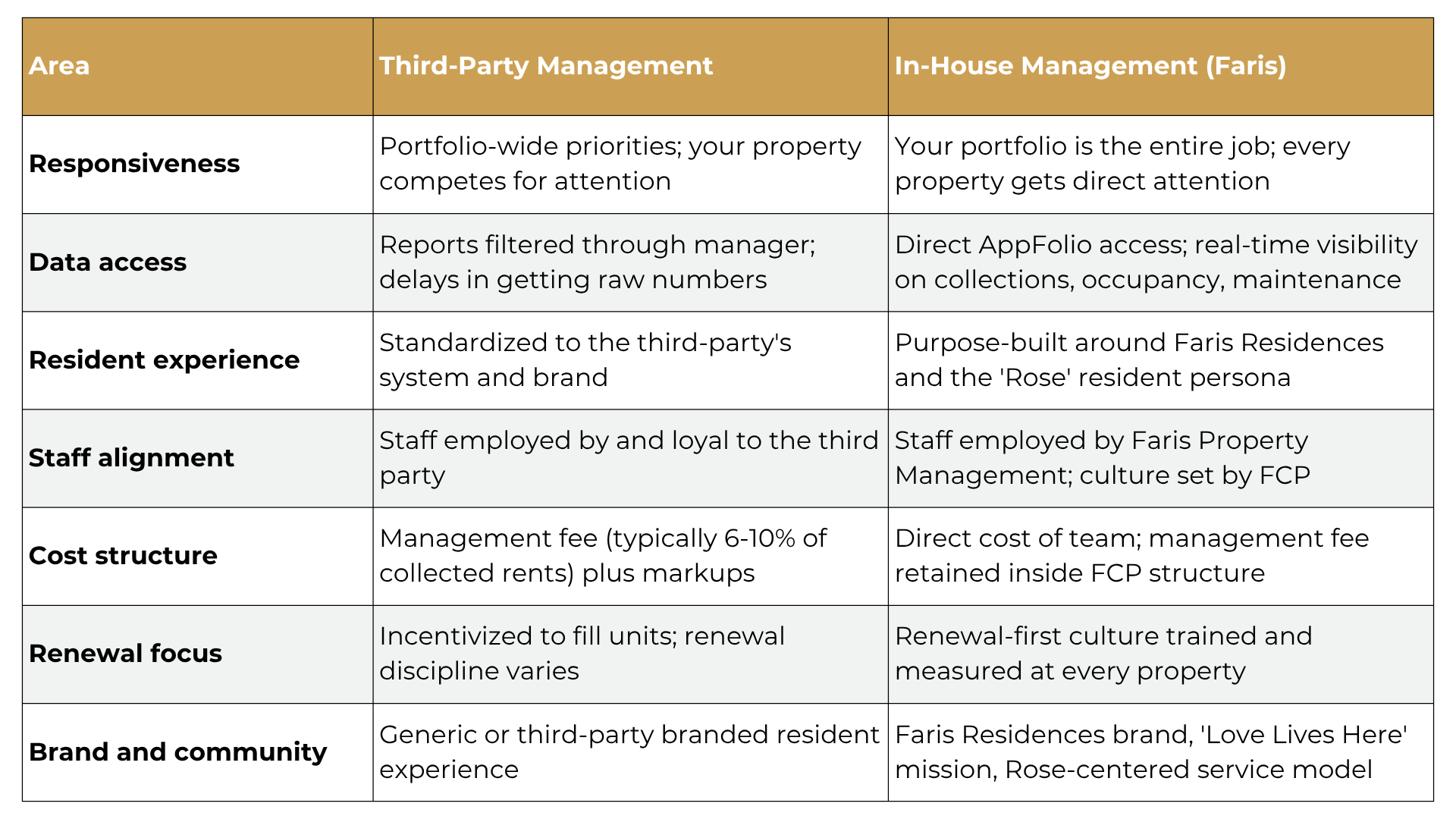
The comparison, clearly:
Note: Third-party management characteristics are generalizations based on FCP's operational experience. Individual third-party managers vary in quality and focus.
Investor takeaway: The financial case for in-house management is not abstract. It is quantifiable, direct, and compounding. The management fee improvement benefits NOI in year one. The renewal improvement benefits NOI in year one and compounds as the resident culture matures. The data advantage benefits decision-making in real time. Together, they represent a meaningful improvement in portfolio performance that grows more pronounced over each successive year of operation.
In simple terms: Here are the numbers that matter. We were paying an outside company roughly $600,000 to $700,000 a year to manage our apartments. Now that cost is replaced by the actual cost of our own team. On top of that, if we keep just 5% more residents from moving out each year – 28 people across 563 apartments – we save about $140,000 in the costs of finding, qualifying, and moving in replacement residents. Capitalize that at a reasonable rate and that's $2.5 million in added property value. From better resident retention alone.
6) What Comes Next – and What Investors Will See
We will go live on October 1st, 2026. We want to be honest about where we are: the infrastructure is built, the team is in place, and the work of turning that infrastructure into operational results is underway. Transitions take time to mature. Here is what we are focused on and what investors should expect to see.
Q4 2026 priorities: Getting our team trained and operating consistently to the standard our manuals define. Completing the AppFolio migration and ensuring data is clean and reliable across all properties. Establishing the renewal cadence and resident communication rhythms that will drive retention through the coming leasing cycle. We are building Sessions 3 through 6 of our staff training program – covering maintenance operations, legal compliance, resident screening, and emergency response. The goal is a fully trained team, operating from shared documented standards, by the end of Q4.
What investors will see over time: The benefits of in-house management compound. The first quarter shows up in team alignment and process consistency. The first year shows up in renewal rates and maintenance response times. The second and third years show up in NOI, resident tenure, and the kind of reputation that makes a community's occupancy self-sustaining.
Our commitment to transparency: We will report on renewal rates, collections performance, maintenance metrics, and NOI trajectory in our quarterly investor updates. In-house management is a commitment to accountability – and we are holding ourselves to it. This is not a decision we made and then step back from. It is an operational philosophy we have built into how our company runs – and the results will be visible in the numbers we report.
On third-party management going forward: For any future acquisitions where the investor structure requires a third-party manager, we will be deliberate about selection. We have built a rigorous diligence process – 41 operational questions across seven modules – for evaluating third-party managers. We know what good looks like. We will not settle for less. But the aspiration is to manage our portfolio directly, at scale, with the same team, the same systems, and the same standards across every Faris Residences community. That is the organization we are building.
Investor takeaway: The in-house management transition is real, it is operational, and the accountability structure is in place. We are not asking for patience in the abstract – we are committing to specific metrics, reported on a specific schedule, against which our performance can be measured. That is what in-house management makes possible that third-party management cannot: full transparency, full accountability, and full alignment between our interests and yours.
In simple terms: We're three weeks in. The hard work of building is done – now comes the work of operating to the standards we've set for ourselves. We'll report the numbers to our investors every quarter: how many residents renewed, how fast maintenance got done, how collections performed. We're not asking you to trust us without verification. We're asking you to watch what happens – because we believe the results will speak for themselves.
7) A Note to Investors Evaluating Any Apartment Investment
The decision to build Faris Property Management was made for our portfolio and our investors. But it raises questions that every passive investor in a multifamily syndication should ask about any operator they back:
Who manages the property, and what accountability does the operator have over day-to-day operations? The answer tells you a great deal about alignment. An operator who delegates management to a third party has limited visibility, limited control, and an inherent conflict between the manager's incentives and the investor's interests.
How does the operator track performance? Real-time data access versus monthly reports is not a minor difference. It is the difference between managing proactively and discovering problems after they compound.
What is the operator's renewal philosophy? Renewal rates are the most direct operational indicator of how well a community is run. Ask what the current renewal rate is, what the target is, and what specific operational practices are in place to drive retention.
What happens when management doesn't perform? With third-party management, replacing a poor manager is a major disruption. With in-house management, accountability is internal and direct. The cost of management failure is absorbed differently depending on who manages the property.
These are not adversarial questions. They are the questions that separate good investment decisions from uninformed ones. We welcome them, because we have built an operation designed to answer them with specifics – not generalities.
In simple terms: If you're ever considering investing in an apartment deal – ours or anyone else's – ask these questions: Who manages the property? How do they track performance? What's the renewal rate? What happens when things go wrong? The answers tell you whether the operator is truly in control of their portfolio – or whether they're trusting someone else with the most important lever in the business.
Faris Property Management at a Glance
Entity: Faris Property Management, LLC – wholly owned affiliate of Faris Capital Partners; Mark Faris, Manager
Go-live date: October 1st, 2026
Resident-facing brand: Faris Residences | Mission: 'Love Lives Here'
Portfolio managed directly: 5 of 7 properties – Epson Oaks (Georgetown, SC); Churchill Apartments and Strawberry Station (Moncks Corner, SC); Oasis at Bayside East (Largo, FL); Brighton Way (Smyrna, GA)
Retained with third-party manager: Goose Creek and Moncks Corner (investor election)
Leadership: Abel Leonardo, Director of Asset and Property Management; Madison McCarty, Director of Finance
Infrastructure: 5 operational manuals, 58 documented processes; 6-session staff training program; AppFolio property management software; executed management agreements and lender-approved business plans across all 7 properties
Resident persona: Rose – workforce housing / essential worker, including Hometown Heroes and first responder households
Illustrative financial case: 5-point renewal improvement across 563 units = ~28 fewer turns/year = ~$140,000 NOI improvement annually = ~$2.5M additional asset value at 5.5% cap rate
The Bottom Line
On October 1st, 2026, we will take direct control of property management for five of our seven apartment communities by launching our own company: Faris Property Management, LLC. We did this because four years of working with third-party managers taught us that the information gap, the accountability gap, and the culture gap are structural features of that model – not problems any individual manager can fully solve. We built 58 documented operating procedures, a six-session training program, a new software platform, and hired dedicated leadership whose entire job is our portfolio. The financial case is specific: we're replacing $600,000 to $700,000 in annual third-party fees with our own team cost, and we expect to reduce resident turnover meaningfully – which at $5,000 per turn adds up to real money that previously walked out the door. We will report the results to our investors every quarter. Not claims. Results. Faris Property Management is how our investment thesis becomes a resident's daily experience – and a return for the people who invest alongside us.
Our team specializes in identifying and renovating underperforming multifamily assets, aiming to create strong, reliable returns - even in turbulent times. We'd love to hear about your goals and discuss how value-add U.S. apartments might fit into your investment strategy.





2.png)
34.png)
7.png)
ujo.png)
_cost%20of%20living.png)
cdvb.png)
fj.png)
fh.png)
bhn%2C.png)
hn.png)
rt.png)

uj.png)
vfd.png)
vfdnh.png)

bhn.png)
4e.png)
vcfcb.png)
gbtr.png)

mj.png)
nh.png)

klo.png)
_war.png)
mkj%20(2).png)


ggj.png)

p.png)

ok.png)
-n%5D.png)